SpaceTime: A Browser-Based 3D Universe Explorer
A passion project that grew into a serious astronomy tool. Browse a sub-arcsecond-accurate solar system, stand on the Moon or Mars, fly out to the cosmic web, watch a total eclipse darken the sky, relive Apollo, and plan tonight's real observing session. 60fps, VR optional, entirely in the browser.
The Story
SpaceTime started as a passion project: the astronomy tool our team wished they'd had in school. Existing software fell into two camps. Professional desktop tools were inaccessible to students, and the pretty apps quietly sacrificed scientific accuracy for looks.
The brief we set ourselves: a browser-based universe explorer with the positional accuracy of desktop planetarium software, the feel of a game, 60fps, and optional VR. The weekend experiment grew into a ~96,000-line application that spans the whole universe. You can stand on the Moon, fly to TRAPPIST-1, watch a total eclipse darken the sky, ride along with the Parker Solar Probe, or plan tonight's actual observing session, all without leaving the browser. Today it is used by educational institutions worldwide.
See It In Action
Two dozen looks at the same app, from a planet's surface to the edge of the observable universe. Drag, tap a thumbnail, or use your arrow keys.
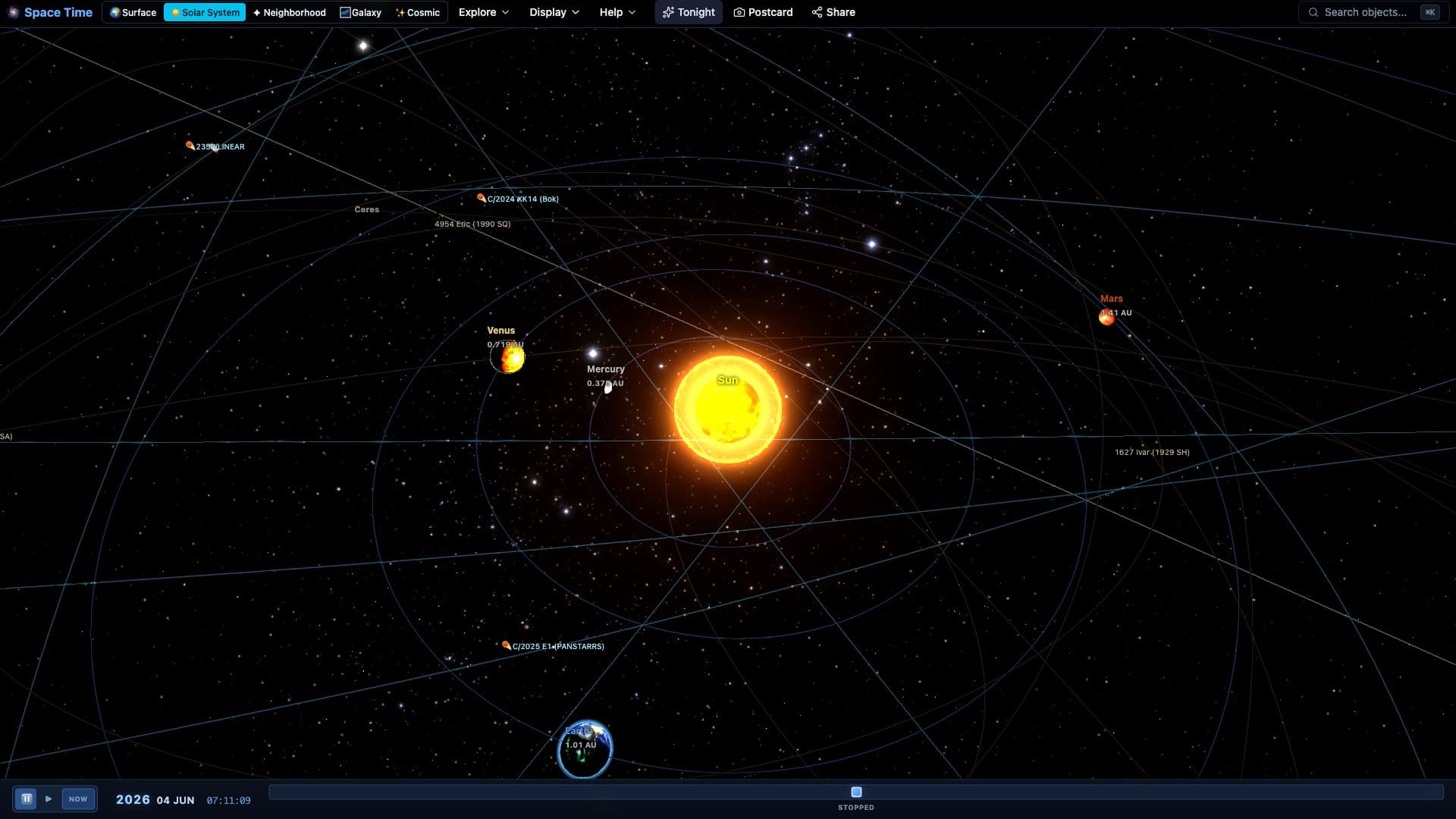
Real-Time Solar System
Every planet, moon, and dwarf planet on accurate JPL orbits, rendered at 60fps in the browser.
Engineering Highlights
Clean separation across a React UI, a Zustand state store, and a Three.js rendering core, each behind well-defined interfaces. That is what keeps a 96,000-line, feature-dense codebase maintainable, and covered by 600+ automated tests.
Positions come from the astronomy-engine library (JPL Development Ephemeris data), augmented with real TLE + SGP4 satellite propagation and live JPL comet/asteroid elements. Planet positions match professional planetarium software to within an arcsecond.
Custom GLSL shaders drive atmospheric scattering, eclipse shadows, auroras, and a half-million-star field, with selective bloom and adaptive resolution holding 60fps. There is no server: the app runs client-side and deploys as static files.
Everything We Built
Thirteen capability areas, covering the solar system, the deep sky, real-world observing, and the engineering underneath.
All eight planets, their major moons, dwarf planets, asteroids, and live comets, every one on its true orbit from JPL ephemeris data. Rendered with real surface maps, ring transparency, terrain relief, and ocean glint at a steady 60fps.
A first-person planetarium from the surface of Earth, the Moon, or Mars. Look up at a scientifically exact sky: constellations, the Milky Way, and the planets in their real positions for any date, time, and location.
One continuous pull-back across every scale: the solar system, the nearby stars, the full Milky Way with Sgr A* and galactic rotation, and the local universe of galaxy clusters out to the CMB. There is also a narrated Cosmic Zoom-Out that does the whole trip for you.
Solar and lunar eclipses predicted and rendered for your exact location. At totality the sky darkens and the corona emerges; during a lunar eclipse Earth's umbra paints the Moon blood-red. Both use true relative sizes and local timing.
Relive the Apollo missions on their historical trajectories, or ride bolted to a live spacecraft (the ISS, Hubble, JWST, or Parker Solar Probe) looking back at Earth and the Sun in real km/s.
Tools for actually going outside: a Tonight's Best session planner, a go/no-go Night Verdict, altitude curves, rise/transit/set tables, a telescope-and-sensor framing simulator, coordinate grids, a push-to finder, and measurement tools.
A searchable catalog of 207 galaxies, nebulae, and clusters illustrated with real survey photography and a sky-conforming deep-zoom. Underneath sits a streamed star catalog that reaches 2.5 million stars (HYG + Tycho-2), every one clickable with its designation and Gaia DR3 distance.
Jump straight to the headline-makers: interstellar visitors like ʻOumuamua and 2I/Borisov, sampled asteroids, planetary-defense targets, and historic spacecraft. There is also a catalog of real neutron stars and pulsars rendered with sweeping radio beams.
Travel to real exoplanet systems like TRAPPIST-1 and Kepler-90, with planets on their true orbits and the habitable zone shaded. A one-tap overlay drops our own Solar System in at the same scale for comparison.
Everything here updates live. Real comets and asteroids streamed from JPL, upcoming rocket launches with countdowns, near-Earth close approaches from JPL CNEOS, and NOAA aurora readings that drive an actual auroral oval over Earth.
A mobile AR compass mode uses your device's orientation and a true-north (WMM2025) correction to label exactly what's overhead: planets, stars, and deep-sky objects. The whole app is built to work on a phone.
Light-travel mode, fly-to camera choreography, a postcard capture mode, dark-adaptation night vision, data sonification, and shareable teleport links that restore the exact view, date, and mode for anyone you send them to.
~96,000 lines of TypeScript across a clean three-layer architecture (React UI · Zustand · Three.js), 600+ automated tests, custom GLSL shaders, WebXR/VR support, and zero backend. The entire universe runs in the browser.
The Result
SpaceTime is now used by educational institutions worldwide as a teaching tool. Students explore the solar system, watch eclipses, and relive historic missions; backyard astronomers plan real sessions and frame targets through their own gear. All of it runs from a browser or a VR headset.
Tech Stack Used
Want Something Like This Built?
3D visualization, AI platforms, real-time data: we build complex, production-grade applications that run in the browser. Tell us what you need.
Get Your Free AssessmentWe’ll confirm scope, pricing, and the next available start date before paid work begins.