The Death of the 10x Engineer: Why 3-Person Teams Outship 30-Person Departments
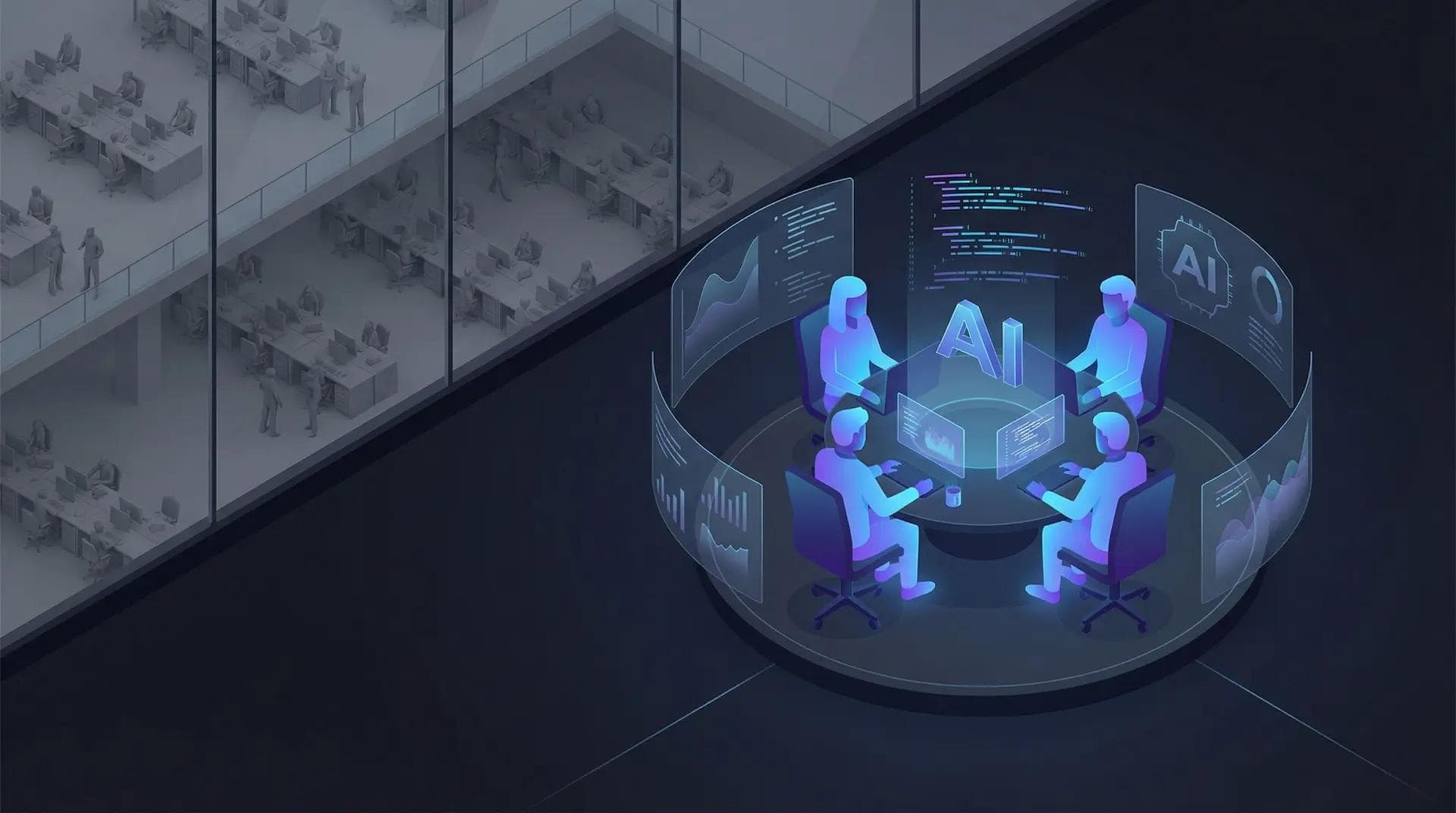
The Old Productivity Math Just Broke
For decades we ran on a simple equation: more features meant more engineers. Need to move faster? Hire faster. Scaling the product meant scaling the team. We all did it because it worked.
The 10x engineer myth fit neatly into that model. You couldn't clone your best people, but you could hire around them and build pyramids. One exceptional senior architect, three solid mid-level engineers, six juniors to handle the grunt work. The math made sense.
It doesn't anymore.
AI changed what "force multiplier" means. The 10x engineer isn't gone because exceptional people stopped existing. The label stopped meaning much because AI made almost anyone capable of that kind of output, provided they know how to use it.
The Data Behind Small Team Dominance
The 2026 numbers should worry anyone still hiring like it's 2022.
Index.dev's latest developer survey found 84% of developers now use AI tools daily. The figure that actually matters: 41% of all code being written is AI-generated. Not AI-assisted. Generated.
So nearly half the code shipping to production right now was written by machines rather than humans.
The World Economic Forum put it plainly in a recent tech report: "GenAI is making sophisticated technology accessible, empowering small teams to accomplish what previously required large departments."
I'm watching this happen in real time. One startup in our network has kept exactly seven engineers for the past 18 months. Their direct competitors scaled from 15 to more than 40 engineers in the same period. The output is roughly equivalent, and the startup is actually shipping faster.
When I asked their CTO how they pulled it off, he said: "Every time we felt pressure to hire, we instead invested in better AI tooling and training. Turns out that was the right bet."
Why Communication Overhead Kills (And AI Doesn't Have This Problem)
Every engineering leader knows large teams are slow because people are the bottleneck. Few want to admit it.
Communication overhead scales at O(n²). A 30-person team has 435 potential communication channels. A 3-person team has 3.
In practice that looks like a lot of things you've probably lived through:
- Three days of calendar Tetris to schedule a design review
- Slack threads with 47 messages where the decision could have been made in one
- Status meetings to prepare for status meetings
- The one person who has to be in every conversation because they touched that code six months ago
Large teams don't move in hours. They move in sprints, if you're lucky.
Small teams move in hours because there's no coordination tax. When the whole team fits in a single Slack huddle, decisions happen at conversation speed.
AI doesn't need status updates. It doesn't have opinions about code style that have to be debated. It doesn't go on vacation right when you need a critical review.
AI handles the grunt work that used to require three junior engineers coordinating through two mid-level reviewers before a senior signed off. Now it's one senior with Claude Code, shipping the same output in a tenth of the time.
The New Team Structure That's Actually Working
The traditional team pyramid is dying. You know the shape: one senior architect, three mid-level engineers, six juniors doing the repetitive work. It made sense when human hours were the only way to get code written.
What's replacing it looks very different.
The new model is flat. Three to five senior engineers, all AI-fluent, no pyramid. No juniors handling boilerplate. No mid-level engineers shepherding tasks up and down the chain.
That sounds extreme until you understand what AI-fluent actually means, and I'll get to that. These aren't senior engineers who happen to use autocomplete. They've changed how they work.
One engineering director told me: "We're not hiring for years of experience anymore. We're hiring for AI fluency plus architectural judgment. That's the combination that ships."
The juniors aren't gone. They're just not writing boilerplate. The smart teams keep small numbers of juniors and use them differently, putting them on architecture and system design from day one because AI handles everything else.
What AI Fluency Actually Means Beyond Autocomplete
Using autocomplete doesn't make you AI-fluent. Neither does accepting every suggestion that pops up in your editor.
AI fluency is understanding when AI helps and when it hurts.
I've watched developers waste entire afternoons fighting AI-generated code that would have taken them 20 minutes by hand. I've also watched developers ship in one day what would have taken a team of four a full sprint.
The difference comes down to knowing which problems AI solves well.
AI is exceptional at:
- Boilerplate and repetitive patterns
- Test coverage for standard cases
- Documentation and comments
- Code translation between languages
- Implementing well-defined specifications
AI is still bad at:
- Novel architectural decisions
- Debugging complex distributed systems
- Understanding nuanced business requirements
- Making judgment calls about technical debt
The AI-fluent engineer knows this instinctively. They don't fight the tool. They use it for what it's good at and handle the rest themselves.
Prompt engineering has become a core skill rather than a gimmick. The engineers shipping 10x faster aren't using better AI. They're asking better questions.
And they know their tools. Claude Opus 4.6 for complex reasoning and architectural work. Cursor for real-time pair programming. They match the tool to the job instead of reaching for whatever's trendy.
The Uncomfortable Truth About Junior Hiring
This is the part nobody wants to say out loud, so I'll say it. The junior developer hiring calculus has changed.
Not because juniors can't become great engineers. They absolutely can and will. The problem is that the traditional junior role, writing tests, fixing bugs, implementing straightforward features, is exactly what AI does best.
Companies used to hire junior developers to handle repetitive work while learning the codebase. That pathway is compressing fast.
The juniors who thrive in 2026 skip straight to the interesting problems. They're learning system design instead of syntax. They're making architectural decisions instead of writing CRUD endpoints for the hundredth time.
Some roles aren't being eliminated so much as compressed. What used to require a junior, a mid-level reviewer, and a senior architect now requires one senior engineer with Claude Code. The three jobs don't collapse into one. The coordination overhead between them disappears.
The gap between AI-fluent and AI-resistant teams is widening faster than anyone predicted. Six months ago the difference was measurable. Now it's existential.
Teams that haven't adapted are competing with teams that ship at 5-10x their velocity with a fraction of the headcount. That position doesn't hold for long.
Making the Shift: What Actually Works
If you lead a team and this sounds uncomfortably familiar, here's what I've seen work.
Start by auditing your team honestly. Who's actually shipping code, versus who's coordinating, reviewing, and managing process? You'll probably find your real "makers" are a smaller group than your headcount suggests.
One VP did this exercise and found that 60% of the team's time went to coordination overhead. Not building. Coordinating.
Next, invest in tooling before headcount. The next time you feel pressure to hire, pause. What would happen if you spent that salary budget on AI tooling, training, and infrastructure instead?
In practice that might mean:
- Claude Opus 4.6 API credits for the whole team
- Cursor licenses for everyone
- A week of dedicated time for engineers to actually learn these tools
- Better prompts, better workflows, better integration
One team I know postponed two senior hires and spent that budget on AI infrastructure. Three months later they're shipping faster than they would have with those two new people, and they don't have two more people in every meeting.
Then give small teams "impossible" timelines and see what happens. This sounds reckless. It isn't.
Take a project you'd normally assign to 8-10 engineers for a quarter. Give it to your three best AI-fluent engineers for six weeks. Make it clear up front that this is an experiment.
You'll learn more about what's actually possible than any amount of planning will tell you.
I've watched this experiment run a dozen times now. It fails sometimes, usually when the team isn't actually AI-fluent yet. When it works, it changes how the whole organization thinks about capacity.
What This Means For Your Organization
We're watching a real shift in how software gets built. Not in five years. Right now.
The companies adapting fastest aren't the ones with the most engineers. They're the ones willing to rethink how they ship.
Small, AI-fluent teams are outshipping departments ten times their size. This isn't theory. It's happening across dozens of the companies we work with.
The shift is coming either way. The real question is whether you adapt while you still have a choice, or wait until your competitors make the decision for you.
At Point Dynamics, we help engineering teams ship with a fraction of the headcount. We've spent the last year figuring out what actually works rather than what sounds good in a blog post. If you're ready to rethink how your team builds software, get in touch.